Introduction: Why You Should Care About Comets
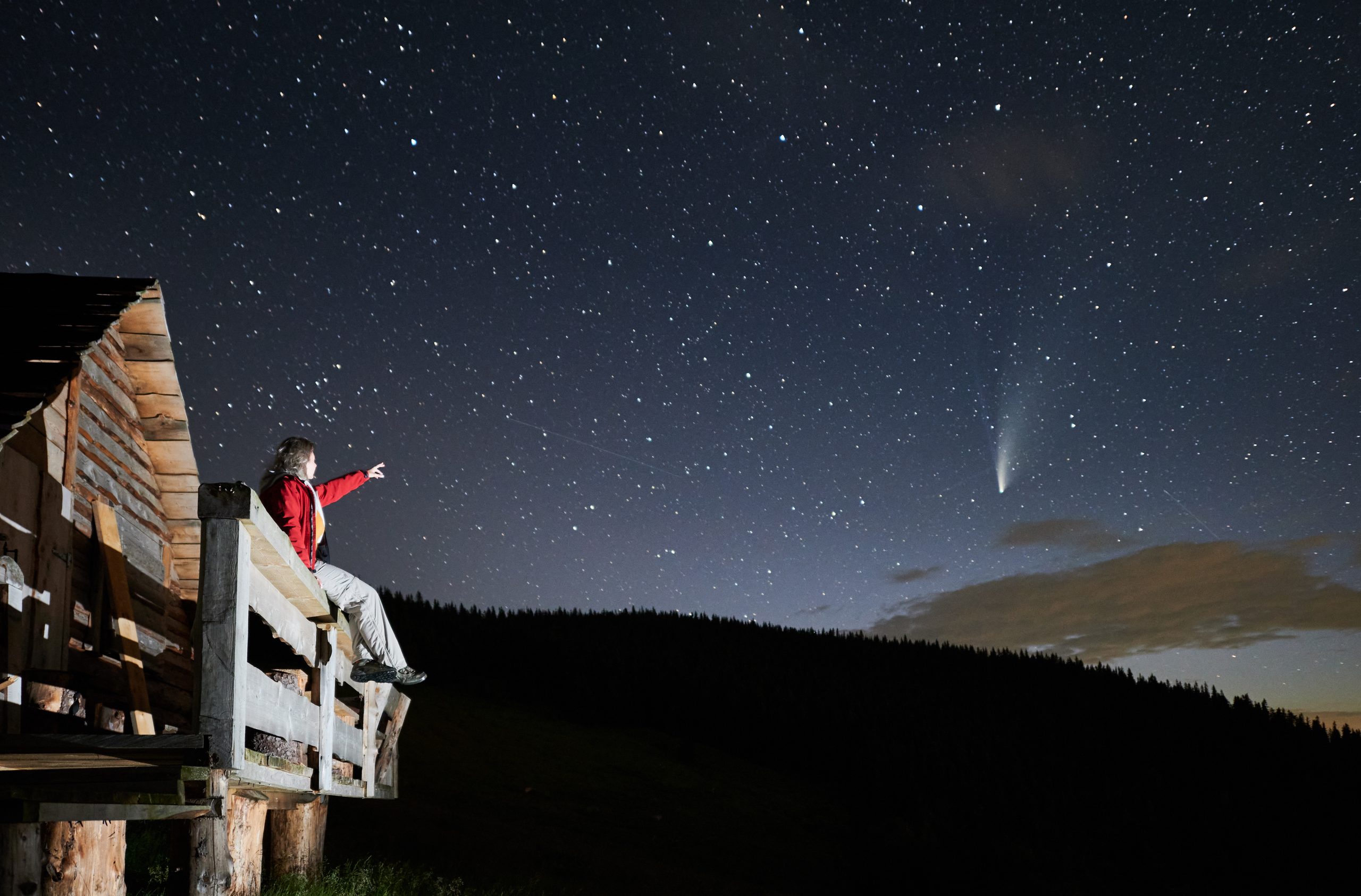
There’s something awe-inspiring about watching a glowing object streak across the night sky. It’s a reminder of how vast, mysterious, and beautiful our universe is. Comets, often described as “dirty snowballs,” offer one of the few astronomical events you don’t need a telescope or a science degree to enjoy. In this blog, we explore what comets are, where they come from, how to see one, and why October 2025 might just be your chance to witness a piece of cosmic history.
What Is a Comet, Really?
A comet is essentially a frozen chunk of rock, dust, and ice—leftovers from the formation of the solar system. When it approaches the sun, this icy body heats up, releasing gas and dust to form the glowing head and trailing tail we can see from Earth. In fact, comets usually sport two tails: a dust tail that drifts behind and an ion tail, which is made of charged particles pushed away by solar wind.
These celestial objects can originate from two major places:
- The Kuiper Belt, located just beyond Neptune, is home to short-period comets like Halley’s Comet.
- The Oort Cloud, a much more distant region, sends long-period comets on orbits that can take tens of thousands of years to complete.
The Cosmic Timing: October’s Visitor
In October 2025, a new comet is expected to come close to Earth—close enough that it might be visible with binoculars or even the naked eye. While it won’t be as bright as the spectacular comet of 2024 (which reached a magnitude of -3.8, nearly as bright as Venus), it’s still an event worth marking on your calendar.
This upcoming visitor is thought to originate from the Oort Cloud, and may not pass by Earth again for another 80,000 years—or ever. Planetary defense systems and observatories in China and South Africa first spotted it. It has since been tracked and studied to determine its trajectory, brightness, and potential for visibility.
How to Spot a Comet
You don’t need to be an astronomer to enjoy this spectacle, but a little planning helps. Here’s how to get the best view:
- Location is everything: Find a truly dark sky. Rural areas, cornfields, and dirt roads far from city lights offer the best chances.
- Scout ahead: Make sure the area has a wide-open view with no tall trees or hills obstructing the horizon.
- Timing matters: Use astronomy apps like StarWalk 2 or Stellarium to find when and where the comet will be most visible. Avoid nights when the moon is bright, as it can wash out dim objects.
- Bring tools: Binoculars are often enough, and even your smartphone with a long-exposure setting can capture what your eyes can’t see.
- Watch the magnitude: A comet’s brightness is measured on a magnitude scale—lower numbers are brighter. Most comets need to be at least magnitude 6 or lower to be seen with the naked eye.
The Science and the Magic
Beyond just their beauty, comets are scientific time capsules. Their material hasn’t changed much in billions of years, offering clues about the early solar system. Missions like the European Space Agency’s Rosetta, which successfully landed a probe on Comet 67P in 2014, are helping scientists learn what comets are made of—including water, methane, and even amino acids, the building blocks of life.
Comets have also sparked the imagination and superstition of people for centuries. Once seen as omens of doom or glory, today we view them with curiosity and wonder.
The Meteor Connection
Comets don’t just light up the sky on their own. As they pass through space, they leave behind debris trails. When Earth’s orbit crosses these trails, we get meteor showers like the Perseids and Leonids. Those “shooting stars” you love? Thank a comet for them.
It’s like a glitter trail left by nature’s most dazzling traveler, gifting us sparkling shows in the night sky long after the comet itself has passed.
Practical Tips: Be Ready in October
If you want to catch this October’s comet, here’s a quick checklist:
- ✅ Research moonrise times and aim for moonless nights.
- ✅ Find your stargazing spot in advance.
- ✅ Download a sky-mapping app.
- ✅ Bring binoculars or a phone with night mode.
- ✅ Look west, especially near bright planets like Venus.
- ✅ Dress warm, stay safe, and maybe bring a friend—it’s more fun to share the moment.
Conclusion: A Chance to Look Up and Wonder
Watching a comet pass by is a humbling experience. It connects us to ancient times, reminds us of the vast universe we’re part of, and invites us to slow down and look up. Whether it’s this year’s flyby or a future cosmic visitor, the skies always have something to show us—if we’re willing to look.
So, make plans. Scout your spot. And when October rolls around, don’t miss the chance to see something thousands of years in the making.