
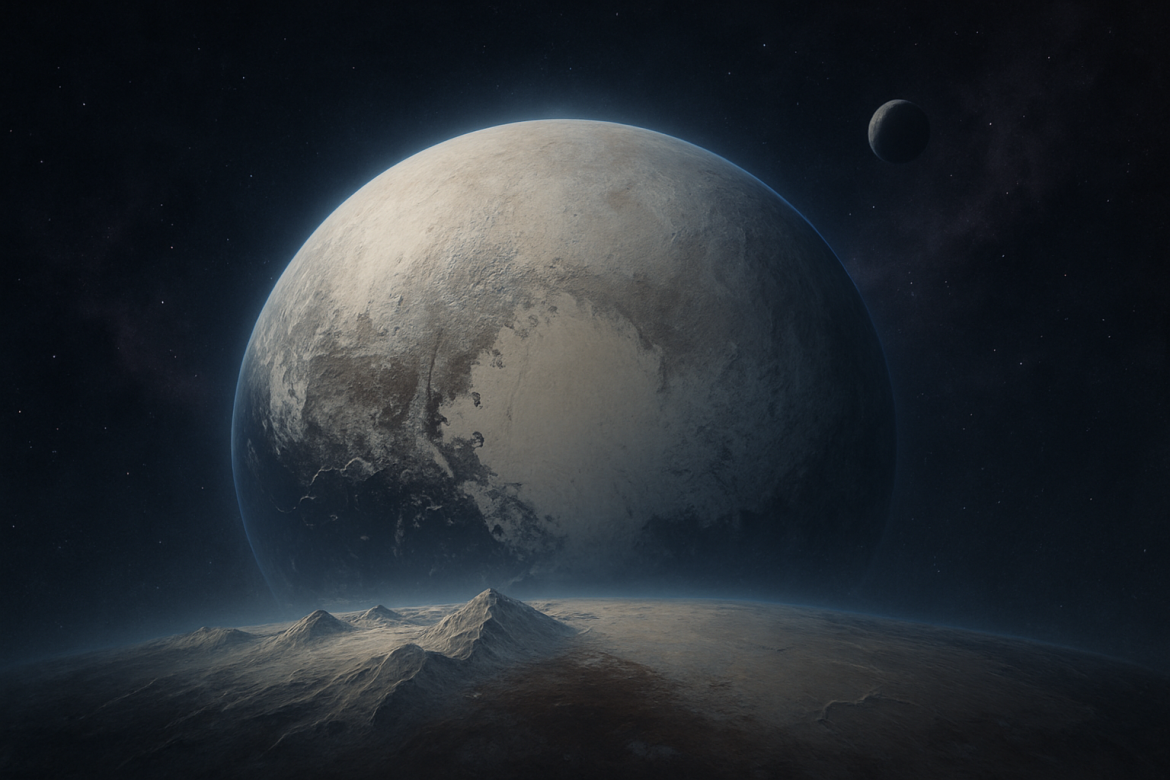
In the vast expanse of our solar system, few celestial bodies have stirred as much public emotion and scientific controversy as Pluto. Once a cherished member of the planetary club, Pluto’s reclassification in 2006 as a “dwarf planet” ignited debates, inspired memes, and prompted many to reconsider what it truly means to be a planet. But beyond the emotional attachments lies a fascinating scientific journey that reveals Pluto as one of the most unique and intriguing objects in our solar system.
The Discovery of Pluto
Pluto’s story began on February 18, 1930, when astronomer Clyde Tombaugh discovered a small moving dot on a photographic plate at the Lowell Observatory in Arizona. Inspired by Percival Lowell’s prediction of a mysterious “Planet X,” Tombaugh’s discovery filled the gap that astronomers had speculated about for years. It was an 11-year-old girl, Venetia Burney from England, who suggested naming the new planet after the Roman god of the underworld—Pluto—a fitting name for a distant and cold world.
For 76 years, Pluto held its place as the ninth planet in our solar system. Yet, even during this time, astronomers noted that Pluto was a bit… odd.
What Makes Pluto Unique?
Pluto is tiny—only about 1,500 miles wide, which makes it smaller than Earth’s moon. Its orbit is elliptical and highly tilted, meaning it sometimes moves closer to the sun than Neptune. A single trip around the sun takes 248 Earth years, and one “Pluto day” lasts 6.4 Earth days.
Composed primarily of rock, ice, and frozen nitrogen, Pluto is home to five moons. The largest, Charon, is so big relative to Pluto that some scientists classify them as a binary system. Their shared center of gravity lies outside of Pluto itself, further emphasizing just how unusual this pair is.
The Planetary Controversy
The great planetary debate began in 2006 when the International Astronomical Union (IAU) introduced a new definition of what constitutes a planet. To qualify, an object must:
- Orbit the sun.
- Be spherical due to its own gravity.
- Have “cleared the neighborhood” around its orbit.
Pluto failed the third criterion. While it orbits the sun and maintains a spherical shape, it shares its orbit with many other icy objects in the Kuiper Belt. And so, Pluto was demoted to “dwarf planet” status.
This decision didn’t go over smoothly. Pluto lovers rallied. Late-night shows made jokes. Some scientists objected. But most importantly, the demotion highlighted how much we still have to learn about the outer reaches of our solar system.
The New Horizons Revelation
Just before the reclassification, NASA launched the New Horizons spacecraft in 2006. It reached Pluto in July 2015 after a 9.5-year journey. What it found stunned the world.
Far from being a dead rock, Pluto was geologically active. New Horizons captured images of a massive heart-shaped glacier, towering ice mountains, and possibly even cryovolcanoes—volcanoes that erupt with water and ice instead of molten rock. Pluto’s thin atmosphere revealed a surprising blue haze, hinting at complex atmospheric chemistry.
These discoveries transformed our perception of Pluto. It wasn’t just a cold rock—it was a dynamic, evolving world.
Friends in the Kuiper Belt
Pluto isn’t alone. It resides in the Kuiper Belt, a region beyond Neptune teeming with icy bodies and dwarf planets. Among them are:
- Eris: Slightly smaller but 27% more massive than Pluto. Its discovery in 2005 helped trigger the IAU’s redefinition. Nicknamed “Xena” by astronomers, Eris has one moon and a highly eccentric orbit.
- Haumea: Shaped like a flattened football due to its rapid 4-hour rotation. It has two moons and a surface covered in crystalline ice.
- Makemake: A reddish, extremely cold object with one faint moon. Named after a deity from Easter Island mythology.
- Ceres: Unlike the others, Ceres is located in the asteroid belt between Mars and Jupiter. It’s the only dwarf planet in the inner solar system and shows signs of water and briny surface materials.
So, What Makes a Planet?
The controversy around Pluto—and the many other bodies like it—has sparked an important scientific conversation. Some astronomers argue that our definition of a planet is too narrow and should be expanded to include Pluto and its peers. Others believe the IAU made the right call to bring clarity and consistency.
Regardless of classification, Pluto’s scientific value hasn’t diminished. If anything, it’s grown. The New Horizons mission and the discovery of other dwarf planets have expanded our understanding of the solar system’s diversity.
What Pluto Teaches Us About the Cosmos
Pluto’s story isn’t just about definitions—it’s about curiosity. It’s about how science evolves with new information. It’s about how even small, icy bodies at the edge of our solar system can captivate the world.
In a way, Pluto’s demotion has only increased its mystique. Once considered a lonely outlier, we now see Pluto as part of a vibrant neighborhood of icy worlds, each offering clues to the formation and evolution of our solar system.
Final Thoughts
Pluto may no longer be officially labeled a planet, but it holds a unique and beloved place in our hearts—and in science. It reminds us that the universe is full of surprises and that every object, no matter how small, has a story to tell. So take a moment to explore the images sent back by New Horizons. They show us that Pluto, far from being forgotten, is more fascinating than ever.